Planning Multi-Day and Multi-Cultural Weddings: A Complete Guide

Kat Trefilova — CEO & Founder
Key Takeaways
Multi-day celebrations follow distinct formats: Indian/South Asian weddings run 3-5 days across mehndi, sangeet, haldi, baraat, and the wedding ceremony; destination weddings span 2-4 days.
Destination weddings average 200+ tasks beyond a traditional wedding — legal paperwork, guest travel, remote vendor coordination, and contingency planning.
Budget realistically: multi-day Indian weddings typically cost 2-3x an equivalent single-day celebration, and destination logistics add 20-40%.
Guest experience is paramount when people invest multiple days: detailed itineraries 6 weeks ahead, built-in rest time, group transport, and a designated point person.
Start earlier than feels necessary — 18 months for destination weddings, 12+ for multi-day cultural celebrations.
Planning Multi-Day and Multi-Cultural Weddings: A Complete Guide
Table of Contents
Introduction: When One Day Isn't Enough
Not all weddings fit into a single afternoon ceremony and evening reception. Our data analysis revealed thousands of tasks related to multi-day celebrations, destination weddings, and cultural ceremonies that span days or even weeks.
Whether you're planning a traditional Indian wedding with mehndi, sangeet, and multiple ceremonies, a destination wedding with welcome events and farewell brunches, or any celebration that goes beyond the conventional format, this guide draws on real-world patterns to help you succeed.
The Multi-Day Wedding Landscape
Our analysis identified several distinct multi-day formats, each with unique planning requirements:
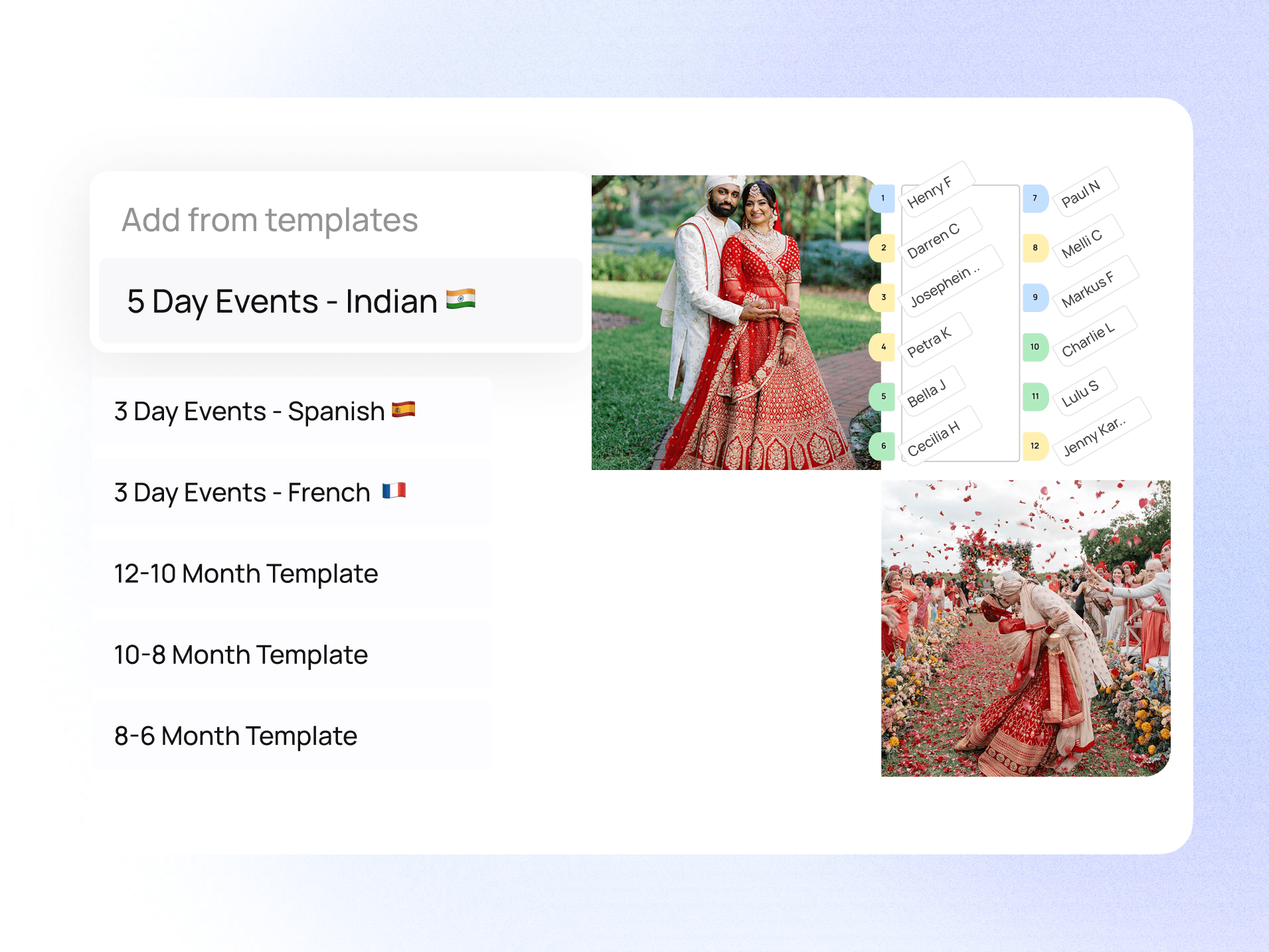
Indian/South Asian weddings: Typically 3-5 days with distinct ceremonies (Mehndi, Sangeet, Haldi, Baraat, Wedding, Reception)
Destination weddings: 2-4 days including welcome events, ceremony, and farewell gatherings
Weekend weddings: Friday welcome, Saturday celebration, Sunday brunch format
Cultural fusion weddings: Combining traditions from multiple backgrounds across multiple events
Indian Wedding Planning: Event by Event
Indian weddings generated some of the most detailed task lists in our data. Here's the breakdown by event:
Mehndi Ceremony
The bride's hands and feet are decorated with intricate henna designs
Book professional mehndi artist (bridal mehndi takes 4-6 hours)
Arrange separate artist for guest mehndi
Plan yellow/green themed outfit for bride
Set up comfortable seating for bride during application
Book dhol players and entertainment
Prepare lemon-sugar mixture for darkening henna
Sangeet Night
Musical celebration featuring choreographed family performances
Book venue with stage and dance floor
Hire choreographer for family dance rehearsals (start 2-3 months before)
Create performance running order
Arrange professional lighting and AV
Plan cocktail-style catering
Coordinate matching/themed outfits for performing groups
Haldi Ceremony
Turmeric paste blessing ceremony for both bride and groom
Purchase haldi and ceremony ingredients
Plan yellow outfits for all attendees
Prepare area for paste application (turmeric stains!)
Arrange traditional puja items
Typically held at home; intimate gathering
Baraat (Groom's Procession)
The groom arrives in a celebratory procession to meet the bride's family
Book dhol players
Arrange transportation (horse, decorated car, or elephant)
Coordinate groom's outfit including sehra (face veil)
Plan procession route to venue
Prepare for milni (family meeting ceremony)
Order flower garlands for milni
Wedding Ceremony (Vivah)
The formal wedding ritual typically conducted around sacred fire
Book mandap (wedding canopy) and decoration
Hire priest and coordinate ceremony details
Arrange for sacred fire (agni) setup safely
Prepare kanya daan items
Coordinate saptapadi (seven steps) around fire
Arrange mangalsutra and sindoor for ceremony
Plan vidaai (bride's departure) ceremony
Destination Wedding Logistics
Destination weddings in our data averaged 200+ unique tasks beyond a traditional wedding. The additional complexity falls into several categories:
Legal requirements: Marriage licenses, apostilles, translations, local regulations
Guest travel: Flights, accommodations, ground transportation, travel insurance
Local vendor coordination: Often working with vendors you can't meet in person until arrival
Multi-event planning: Welcome dinner, wedding day, farewell brunch
Welcome bags: Local treats, itineraries, maps, and essentials for traveling guests
Contingency planning: Weather backups, vendor no-shows, medical emergencies abroad
The Guest Experience at Multi-Day Events
When guests are investing multiple days (and often significant travel), their experience becomes paramount. Our data revealed these best practices:
Create a comprehensive wedding website with schedule, dress codes, and FAQs
Provide accommodation options at multiple price points
Arrange group transportation between events
Include 'free time' in the schedule for guests to rest or explore
Send detailed itineraries at least 6 weeks before
Assign a point person for guest questions during the events
Plan activities for children if many families are attending
Budget Considerations for Multi-Day Celebrations
Multi-day weddings multiply costs in ways couples don't always anticipate:
Venue rentals for 3-5 events instead of 1-2
Catering multiplied across events (mehndi + sangeet + wedding + reception)
Multiple outfits for bride and groom (up to 8-10 for full Indian wedding)
Photography/videography coverage spanning multiple days
Décor and florals for each distinct event
Entertainment bookings for each celebration
Guest hospitality (welcome bags, transportation, activities)
The data suggests multi-day Indian weddings typically cost 2-3x a single-day celebration of equivalent scale, while destination weddings add 20-40% in travel-related logistics.
Timeline Planning for Extended Celebrations
Unlike single-day weddings, extended celebrations require macro-level planning of multi-day event timelines:
Day 1 (Thursday): Guest arrivals, Welcome dinner (casual, 2-3 hours)
Day 2 (Friday): Mehndi (afternoon), Sangeet (evening, 4-5 hours)
Day 3 (Saturday): Haldi (morning), Wedding ceremony (afternoon/evening)
Day 4 (Sunday): Reception (if separate), Farewell brunch
Multi-day schedules also change constantly — a mandap setup runs long, a flight lands late, a venue shifts its access time. In ThatsTheOne you can shift the whole schedule or just the items you select in one bulk update instead of re-typing every entry, and TBD placeholders hold the spot for items whose times aren't confirmed yet.
Common Challenges and Solutions
Multi-day celebrations present unique challenges. Here's what the data revealed:
Challenge: Guest fatigue
Solution: Build in rest periods; make some events optional
Challenge: Vendor coordination across events
Solution: Hire a planner experienced in multi-day celebrations; create master timeline shared with all vendors
Challenge: Budget creep
Solution: Set firm budgets per event; prioritize ruthlessly
Challenge: Family dynamics
Solution: Give both families dedicated hosting moments; communicate expectations early
Challenge: Outfit logistics
Solution: Create a detailed outfit schedule; arrange steaming/pressing between events
Running Multi-Day Celebrations in ThatsTheOne
Beyond the planning principles above, a few ThatsTheOne capabilities are built specifically for multi-day and multicultural work:
City-Based Hotel Search for Guest Accommodation
For destination weddings and multi-day celebrations, guest accommodation research is one of the biggest time sinks. ThatsTheOne lets you search hotels by city — use 'Search this city' to pull up properties near your venues, see live rates and availability, and curate a shortlist of options at multiple price points to share with guests.
One boundary worth knowing: ThatsTheOne does not negotiate hotel room-block contracts, manage attrition, or replace pickup reports — planners still handle block agreements directly with hotels. The platform's job is to make the research and the guest-facing shortlist fast.
Date Formats Your Guests Actually Recognize
Multicultural guest lists often span countries that read dates differently — 05/07 means May 7th to an American guest and 5 July to a British one. ThatsTheOne supports configurable date formats at the business, event, and guest level, so itineraries and schedules display dates the way each audience expects.
Event Labels and Planner Assignment for Multi-Event Teams
When a celebration spans mehndi, sangeet, haldi, baraat, and reception, teams need structure. In ThatsTheOne, you can add an optional label to each event or service as you create it, chosen from a fixed starter list — for example Full Service Planning, Day of Coordination, Birthday Party, or Quinceañera — and assign a main planner plus co-planners to every event. The label and the assigned planners are visible at a glance on the events list, and you can filter that list by label, so a sangeet, a haldi morning, and a ceremony day each stay easy to find in a packed multi-day schedule.
Conclusion
Multi-day and multi-cultural weddings are among the most complex celebrations to plan—and among the most rewarding to experience. The key is treating each event as both a standalone experience and part of a larger journey.
Start planning earlier than you think necessary (18 months for destination, 12+ months for multi-day cultural celebrations), communicate constantly with all stakeholders, and don't forget to build in moments for you, as a couple, to actually enjoy what you've created.
— END OF ARTICLE —
Further reading:
Try your 30 day free trial here or book a demo.
Photo by: Makenzie Rogers | Ananya and Thomas Kingshott Wedding