The Real Numbers: How Many Vendors and Payments?

Kat Trefilova — CEO & Founder
Key Takeaways
Across 21,802 real wedding payments, the average deposit is 38% of the total, and 23% of vendors accept deposits under 20% — worth negotiating.
Bank transfer dominates at 81% of all payments, and its share grows with payment size.
Only 64% of wedding payments are made on time — and cash is the worst offender at just 43%, risking vendor relationships and late fees.
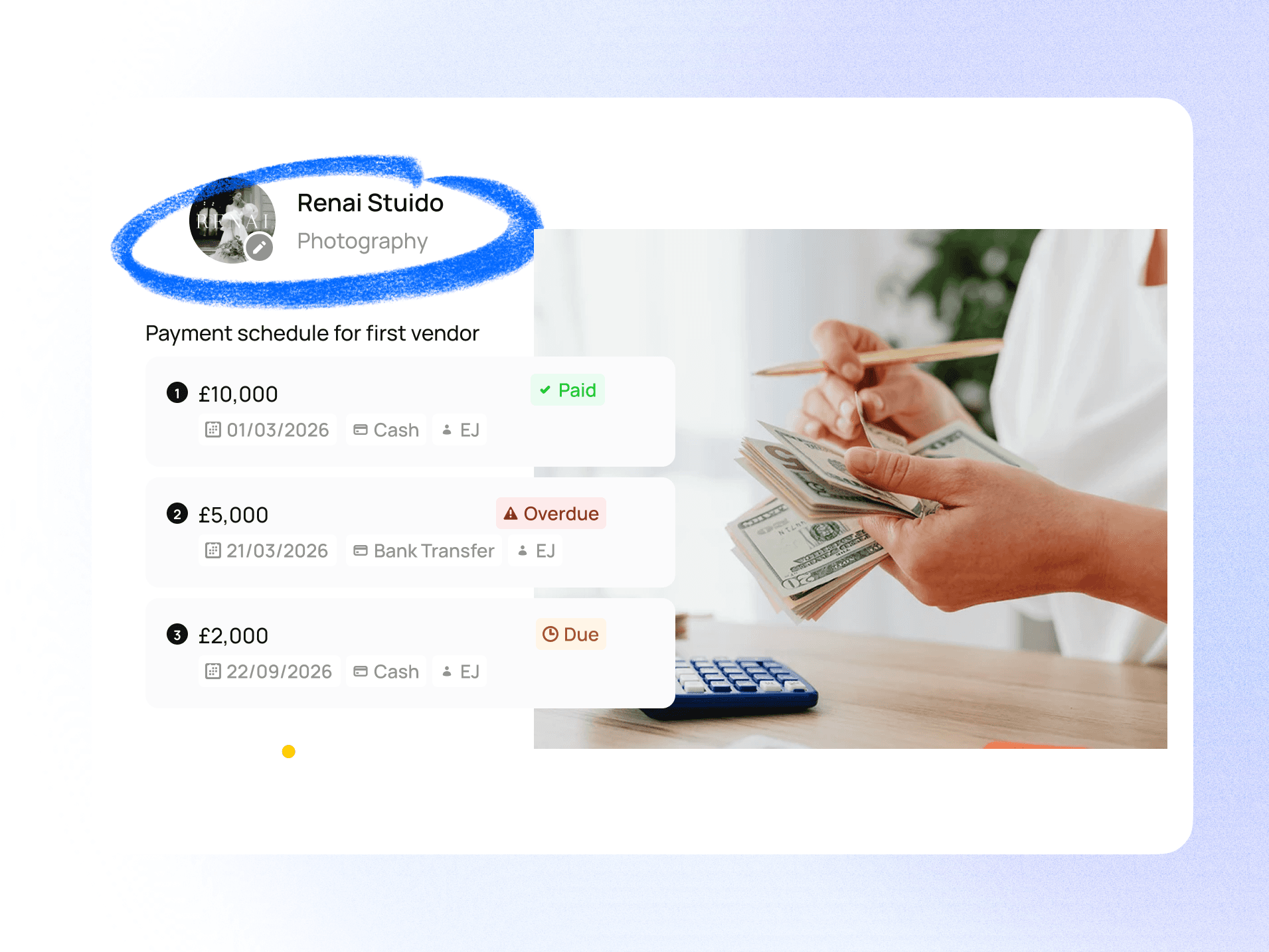
Budget for roughly 13 payment due dates per wedding and track them in one system; deposits come fast (median 10 days after booking) while later installments spread over months.
Table of Contents
The Two-Payment Pattern Decoded
For the half of vendors using two payments, here's how they typically split it:
Average first payment (deposit): 38% of total
Most common range: 35-50% upfront
Some vendors (23%) accept deposits under 20% — worth negotiating if cash flow is tight
Payment Methods: What Real Couples Use
The overwhelming majority of wedding payments—81%—are made via bank transfer. This preference grows stronger with larger amounts:
Payments over $500,000: 86% bank transfer
Mid-range ($50K-$100K): 79% bank transfer
Small payments (under $10K): Still 75% bank transfer but more flexibility with cards (15%)
Credit cards account for just 11% of payments overall. While they offer rewards and protection, many vendors prefer bank transfers to avoid processing fees—some offer discounts for direct payment.
Timing Your Payments: The Planning Timeline
How far in advance are couples making payments?
Average lead time from booking to payment due: 149 days (about 5 months)
Median lead time: 116 days (about 4 months)
Average spacing between payments to same vendor: 130 days
First payments (deposits) come quickly—median just 10 days after booking. But second and third payments spread out: payment #2 averages 157 days out, and payment #3 reaches 190 days.
The On-Time Payment Reality
Here's a surprising finding: only 64% of wedding payments are made on time. That means over a third of payments are late, potentially risking vendor relationships, late fees, or in worst cases, losing your booking.
On-time rates by payment method:
Bank transfer: 66% on time
Credit card: 63% on time
Cash: Only 43% on time — the hardest to track and remember!
Key Takeaways for Couples
Budget for multiple payments per vendor. Don't assume a single deposit and final payment—many vendors have 3+ installments.
Plan for ~13 payment due dates. Use a wedding budget tracker or calendar to avoid missed deadlines.
Negotiate deposit percentages. 23% of vendors accept deposits under 20%—it's worth asking.
Set up bank transfer reminders. Most vendors prefer this method, and it's the most reliable for on-time payment.
Avoid cash when possible. It has the lowest on-time payment rate and leaves no paper trail.
Data based on analysis of 21,802 wedding payments across 23 currencies and 1,653 weddings.
Where these numbers come from
Every figure in this guide comes from 21,802 payments across 23 currencies and 1,653 weddings planned on That’s The One: deposits, instalments and final balances as they were scheduled and paid, not as couples remembered them in a survey.
When deposits go missing: two venue collapses, two endings
The Blazing Donkey, a Kent venue that hosted more than 2,000 weddings over 36 years, went into administration in September 2025 owing over £380,000 to more than 50 booked couples, with 62p left in the bank. The bank was a secured creditor; the couples were not. They expect to get nothing back. The largest single loss was £17,500.
Red Mesa Events in St Petersburg, Florida also went under, in 2026, and its couples got their deposits refunded. The difference: Red Mesa had kept customer deposits in a separate account from operating money, something the couples’ own attorney called “really a unicorn in the bankruptcy process.” That’s worth stealing as due diligence. Ask a venue how it holds deposits, and never pay further ahead of the contract schedule than you must.
Couples’ finances rarely have slack to absorb this. A LendingTree survey of 1,050 newlyweds found 67% took on debt for their wedding, and under half primarily paid from savings. With a third of payments already arriving late (our on-time rate is 64%), one forgotten instalment can turn a stretched budget into a lost booking.
The fix the data points to is boring: build the whole schedule at booking. Deposits get paid fast, at a median of 10 days, because everyone is excited. Payment two lands 157 days later, on average, when nobody is. Reminders a week ahead of each due date do more for vendor relationships than any choice of payment method, though the numbers do say to steer couples away from cash, which arrives on time just 43% of the time. That’s The One gives every wedding a payment tracker with per-vendor due dates, so the 13-payment average stops living in your head.
FAQ
What is a standard deposit for a wedding vendor?
In our data the average first payment is 38% of the total, and 35–50% is the most common band. It’s negotiable more often than couples assume: 23% of vendors in our dataset accepted deposits under 20%, which helps with early cash flow.
Why do so many wedding payments end up late?
Mostly distance, not intent. Instalments sit an average of 130 days apart, spread across a dozen vendors and tracked in whatever spreadsheet survived the venue search. On-time rates barely change with method (bank transfer 66%, card 63%) except for cash at 43%. A single schedule with reminders fixes more than switching payment methods ever will.
Further reading:
Where That’s The One fits in
That’s The One now covers the paperwork behind these numbers, not just the tracking. Planners can build branded proposals, turn them into reusable contract templates, collect legally binding e-signatures, and export everything to PDF — then track every vendor and client payment schedule against those contracts, with per-vendor due dates and statuses.
The division of labour is deliberate: That’s The One tracks payment schedules; it does not collect a penny. Maroo still sends the invoices and processes the payments — while That’s The One keeps the schedule, the statuses and the reminders in one place, so the roughly 13 due dates per wedding stop living in a spreadsheet.
Try your 30 day free trial here or book a demo.