The Industry-Standard Deposit: What Data Shows

Kat Trefilova — CEO & Founder
Key Takeaways
50% is the most commonly quoted deposit (venues, caterers, photo/video), followed by 30% for florists, bands, and planners — from 2,207 explicitly marked deposits.
The 20-40% range is the industry sweet spot; deposits over 60% are a caution zone unless there's a clear reason like custom or imported goods.
Deposits come due fast — median 10 days after booking — so be ready to pay within two weeks of signing.
Almost everything is negotiable: ask for lower percentages, three-way payment splits, or better terms for off-season and bundled bookings.
Protect every deposit: get terms in writing, understand refund policies, and keep all records in one place.
Table of Contents
Deposit Percentages From Payment Notes
When couples and vendors explicitly noted the deposit percentage, here's what we found most frequently:
Deposit % | Frequency | Typical Vendor Type |
|---|---|---|
50% | Most common (146 mentions) | Venues, Caterers, Photo/Video |
30% | Second most common (78 mentions) | Florists, Bands, Planners |
25% | Third (33 mentions) | Hair/Makeup, Smaller vendors |
20% | Fourth (24 mentions) | Entry-level, negotiated |
40% | Fifth (19 mentions) | Mixed—various vendors |
The Deposit Range: What's Normal vs. What's a Red Flag
Based on our analysis of first payments in two-payment structures:
Under 20% Deposit (23% of vendors)
Common for: Smaller services, newer vendors building portfolios, off-season bookings
Benefit: Lower upfront cash requirement, easier to spread costs
Watch for: Very low deposits might mean the vendor isn't holding your date firmly
20-40% Deposit (32% of vendors)
Industry sweet spot. Enough to show commitment; reasonable for couples
Common for: Photographers, florists, planners, musicians
Negotiation tip: If a vendor quotes 50%, ask if 30-35% is possible
40-60% Deposit (35% of vendors)
Standard for: Venues, caterers, high-end photographers, destination vendors
Why it's higher: These vendors turn away other bookings and often incur costs early
Acceptable if: You're booking peak season, high-demand vendor, or far in advance
Over 60% Deposit (10% of vendors)
Caution zone. Should be rare and justified
Acceptable when: Custom items (dress, invitations), imported goods, very small vendors
Red flag if: Standard service, no clear reason, vendor seems desperate for cash
Timing: When Are Deposits Due?
Our data reveals a clear pattern:
First payment (deposit): Median 10 days after booking
Second payment: Median 157 days (5+ months) after first payment
Final payment: Often due 30-60 days before the wedding or on the day
This means: Be prepared to pay deposits quickly when booking vendors. Most expect payment within 1-2 weeks of signing a contract.
5 Strategies for Negotiating Deposits
Ask for a lower percentage. 23% of vendors accept under 20%. It never hurts to ask: "Would you accept 25% as a deposit with the balance due 30 days before?"
Request payment plan flexibility. Instead of 50/50, ask for 30/30/40 across three payments to spread costs.
Offer a credit card deposit, bank transfer balance. Some vendors will accept a smaller card deposit (with its protection) and larger bank transfer for final payment.
Book off-season for better terms. November-February weddings often come with more flexible deposit arrangements.
Bundle vendors for leverage. If booking multiple services (venue + catering, or photo + video), negotiate a package deal with better deposit terms.
Protecting Your Deposits
With the average wedding involving 13+ payments, protecting your deposits matters:
Get everything in writing. Contract should specify deposit amount, due date, refundability, and conditions.
Understand cancellation policies. Most deposits are non-refundable, but policies vary for date changes or vendor cancellations.
Use credit cards for protection when possible. They offer dispute rights if vendors don't deliver.
Consider wedding insurance. Protects against vendor no-shows, cancellations, and unforeseen events.
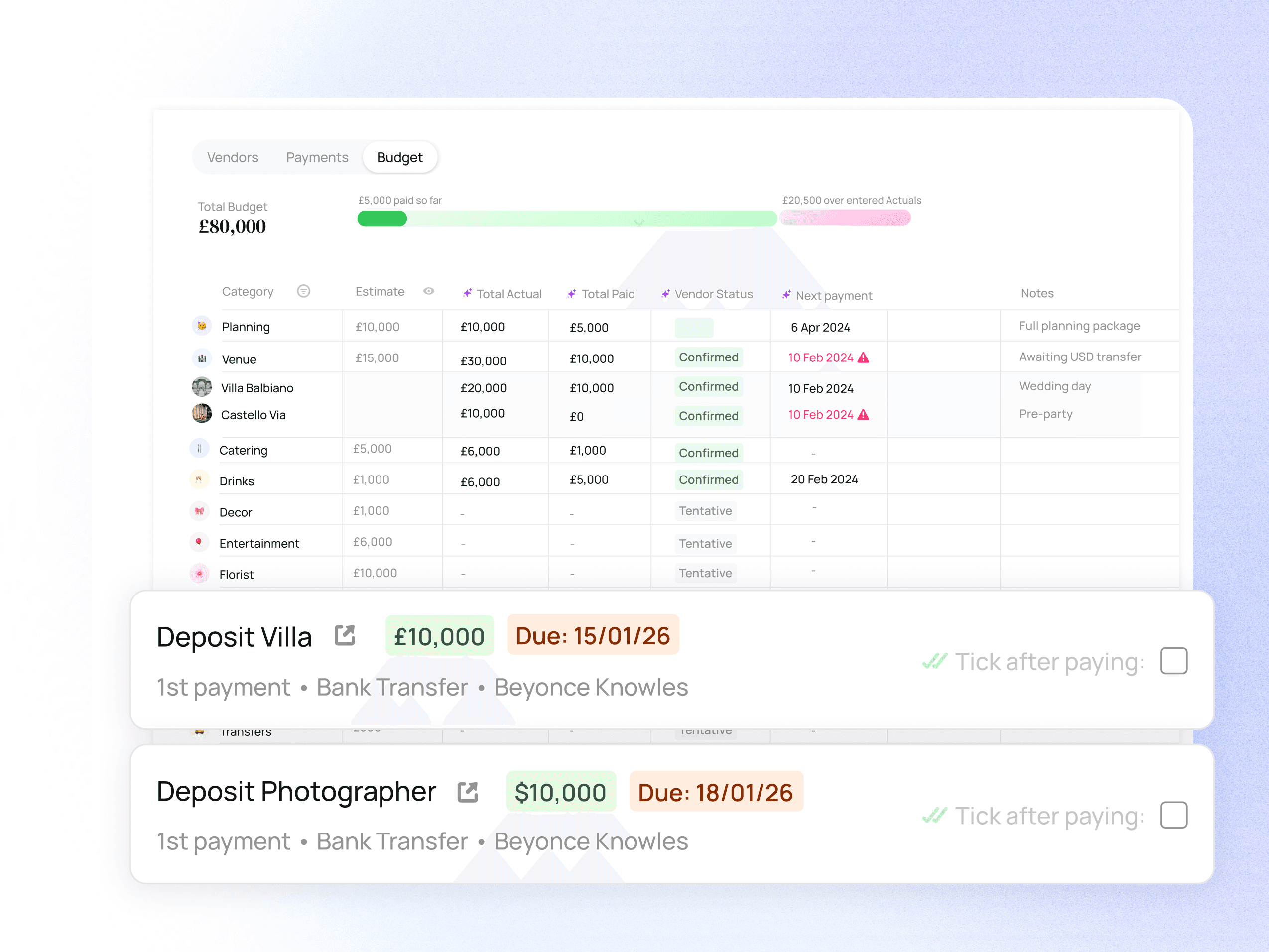
Track every payment. Maintain records of all deposits, receipts, and contracts in one place. That's The One tracks each deposit amount, due date, and what has been paid across every vendor; Maroo or your existing payment processor collects the money.
The Bottom Line
Expect to pay 30-50% upfront for most vendors, with deposits due within 10 days of booking. But remember: these are averages, not rules. Every vendor and every situation is negotiable—especially if you're booking during slower seasons, committing early, or bringing multiple service needs to the same vendor.
The most important thing isn't the exact percentage—it's understanding what you're paying for, when it's due, and what happens if plans change. Armed with this data, you can walk into any vendor conversation confident you know what's standard and what's negotiable.
—
Based on analysis of 21,802 wedding payments including 2,207 explicitly marked as deposits, from 1,653 weddings and 10,614 vendor relationships.
Further reading:
Managing Deposits in That's The One (July 2026)
If you're juggling deposits across a dozen vendors, That's The One now covers the paperwork side natively. As of July 2026, you can send branded proposals, turn them into reusable contract templates with e-signatures, and record each vendor's payment schedule against the event: deposit amount, due dates, and what has been paid so far.
Proposals and contracts. Create branded proposals, reuse contract templates, and get them e-signed without leaving the platform.
Payment-schedule tracking. Log the deposit due 10 days after booking, the mid payment, and the final balance so nothing slips through the cracks.
Tracking, not collecting. That's The One tracks payments; it does not process or collect them. Maroo, or whichever payment processor you already use, handles invoicing and collecting the money, while TTO keeps the record of what is due and what has been paid.
Try your 30 day free trial here or book a demo.