The Vendor Count Reality Check

Kat Trefilova — CEO & Founder
Key Takeaways
Most couples work with 5-6 vendors, based on 10,614 real vendor relationships — 1-2 means all-inclusive or elopement, 11+ signals a luxury production.
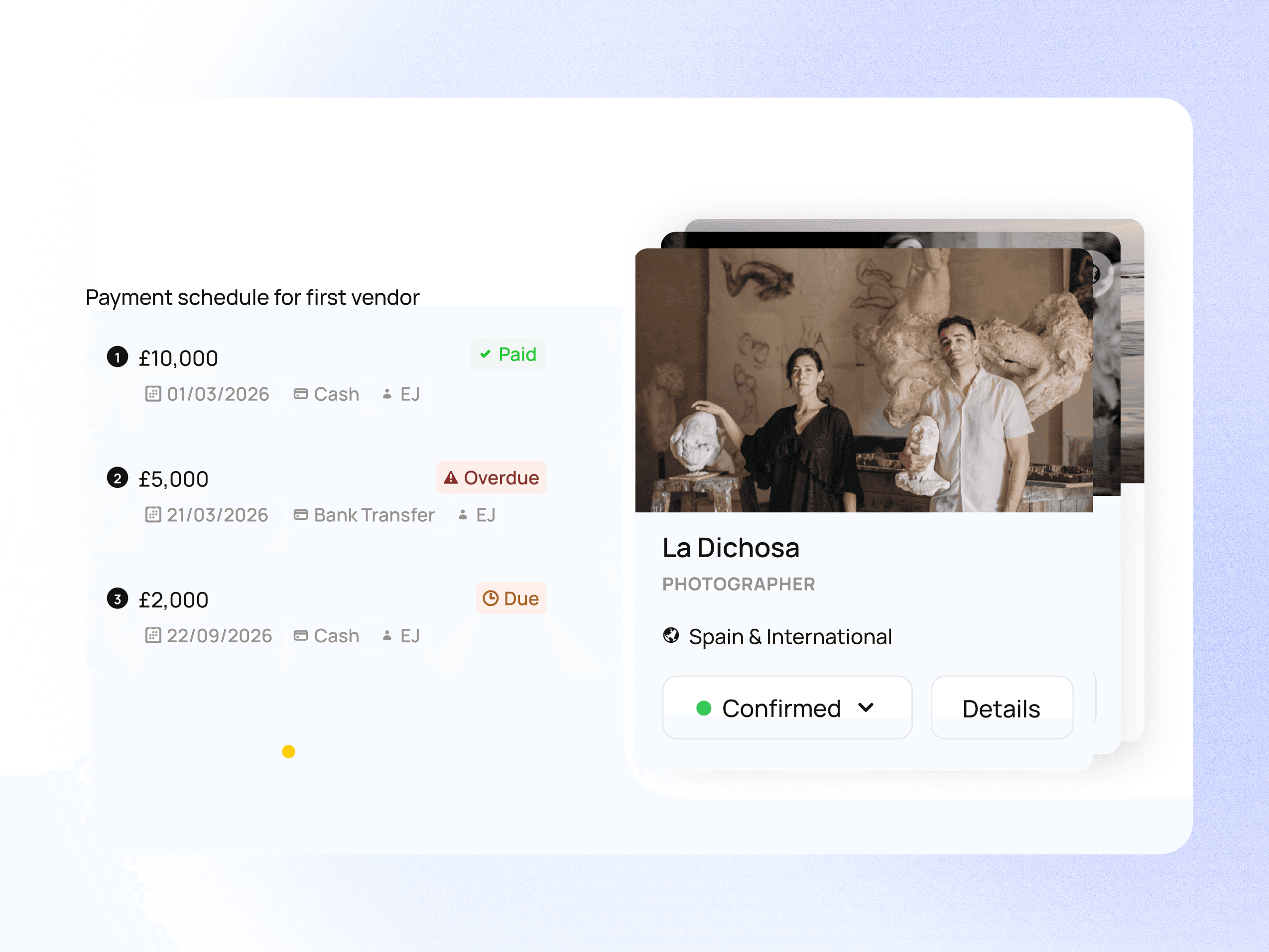
Every vendor averages 2 payments, so a 10-vendor wedding means ~20 payment due dates to track — the most complex weddings exceed 70.
Book in priority order: venue, caterer, and planner 12-18 months out; photographer and entertainment 9-12 months; hair & makeup, transportation, and cake last.
There's no "right" vendor count — decide your approach early (minimalist, essentials, or full experience) and invest in payment tracking that can handle it.
Table of Contents
Vendor Count Distribution
Vendor Count | Typical Approach |
|---|---|
1-2 vendors | All-inclusive or elopement |
3-5 vendors | Essentials-focused |
6-10 vendors | Full experience |
11+ vendors | Luxury / Highly customized |
The Payment Burden: Why Vendor Count Matters
Each vendor you add doesn't just add cost—it adds payment management complexity. Our data shows:
Each vendor averages 2 payments (though some require 3-4)
A 5-vendor wedding means ~10 payment due dates to track
A 10-vendor wedding means ~20 payment due dates
The most complex weddings can have 70+ payments to manage
Building Your Vendor List: Priority Order
Based on our data on which vendors couples pay first and which consume the largest budget share, here's a prioritized booking order:
Book First (12-18 months out)
Venue — Determines everything else (date, capacity, vibe)
Caterer — Often bundled with venue, but if separate, book early
Wedding Planner — If using one, they help with everything else
Book Second (9-12 months out)
Photographer — Top photographers book fast
Videographer — If you want one, book with photographer
Music/Band/DJ — Popular entertainers have limited availability
Book Third (6-9 months out)
Florist — Needs lead time for vision planning
Decor/Rentals — Coordinate with florist and venue
Bridal Attire — Dress alterations need time
Book Last (3-6 months out)
Hair & Makeup — Can often book closer to date
Transportation — Usually available with shorter notice
Cake/Dessert — Bakeries work on shorter timelines
Stationery — Save-the-dates early, but invitations can wait
The Bottom Line
There's no "right" number of vendors—it depends on your vision, budget, and tolerance for coordination. But now you have real data: most couples work with 5-6 vendors, each requiring multiple payments spread across months of planning.
The key is being intentional: decide your approach early (minimalist, essentials, or full experience), build your list accordingly, and invest in a payment tracking system that can handle 10-20 due dates without missing a beat.
—
Based on analysis of 10,614 vendor relationships across 1,653 weddings and 21,802 payments.
How we counted
This analysis covers 10,614 vendor relationships and 21,802 payments across 1,653 weddings planned on That’s The One. A vendor only appears in our numbers if money changed hands and a planner logged it, which makes this a record of what couples really paid for rather than what a checklist says they should book.
Why The Knot counts 13 vendors and we count 6
The Knot’s 2026 Real Weddings Study, based on 10,474 American couples who married in 2025, puts the average at 13 hired vendors, down from 14 the year before. Our median is 5–6. Both numbers are honest; they count different things. The Knot counts every category a couple purchases, including the dress and the groom’s attire. We count vendors with a payment schedule a planner is actively tracking. Nobody chases the dress shop for instalment three.
The gap between those two numbers is the difference between the couple’s shopping list and the planner’s coordination load. New York planner Tzo Ai Ang described that load in Newsweek: on a full-production wedding she is managing the band, photographer, videographer, florist, officiant, hair and makeup, transport, lighting, staging, rentals and the cake, then running the day itself with two assistants on two-way radios. That’s the 11-plus tier in our data, and it carries roughly double the payment admin of an essentials wedding. Price the two as different jobs, because they are.
The multiplier worth memorising is two payments per vendor. A 10-vendor wedding is about 20 due dates; fifteen weddings a season is 300. Spreadsheets don’t fail at one wedding, they fail in October. That’s The One keeps every vendor’s payment schedule and due dates in one view per wedding.
Managing a High Vendor Count in Practice
Once you pass the 6-vendor mark, the job shifts from choosing vendors to coordinating them. Two tools inside That’s The One are built for exactly that. Each event includes an in-event vendor map — a location view that lays out your vendors by proximity, so you can see at a glance who is based near the venue and who is travelling in on the day. And every event carries a centralized vendor CRM: all vendor contacts, statuses, and documents in one place per event, instead of scattered across inboxes, spreadsheets, and phone notes. When you need to hand that list to a client or co-planner, export the vendor PDF with photos, contact details and notes. Use the separate Attached files option when you need the underlying images and documents.
For planners running vendor-heavy productions as a business, the same system extends to native lead capture and pipeline tracking, branded proposals, and reusable contract templates with e-signatures — so the 11-plus-vendor wedding and the client who booked it live in one workflow.
FAQ
How many vendors does a typical wedding have?
Depends who’s counting. Survey data like The Knot’s says 13 hired vendor categories; our payment records say most couples actively pay 5–6. One or two vendors usually means an all-inclusive venue or an elopement, and 11 or more means a luxury build with its own coordination economics.
How many payments does a wedding actually involve?
Plan on roughly two per vendor: around 10 due dates for a 5-vendor wedding, 20 for a 10-vendor one. The most complex weddings in our dataset ran past 70 individual payments.
Further reading:
Try your 30 day free trial here or book a demo.