Crafting the Perfect Wedding Day Timeline: An Hour-by-Hour Guide

Kat Trefilova — CEO & Founder
Key Takeaways
Work backward from the ceremony time — it's the anchor every other timestamp flows from — and build in 15-30 minute buffers between major transitions.
The hair & makeup math from 4,000+ real tasks: 45-60 minutes per person for hair, 30-45 for makeup, bride goes last — a 4PM ceremony with six people styled means a 7AM start.
Cocktail hour is a strategic buffer, not just social time: 60-90 minutes covers photos, the room flip, and a moment for the couple to breathe.
The data-backed reception flow runs grand entrance to send-off in a tested sequence — space speeches through dinner instead of stacking them back-to-back.
The most common timeline mistakes: underestimating transport time, unchecked sunset times, and forgetting vendor meals.
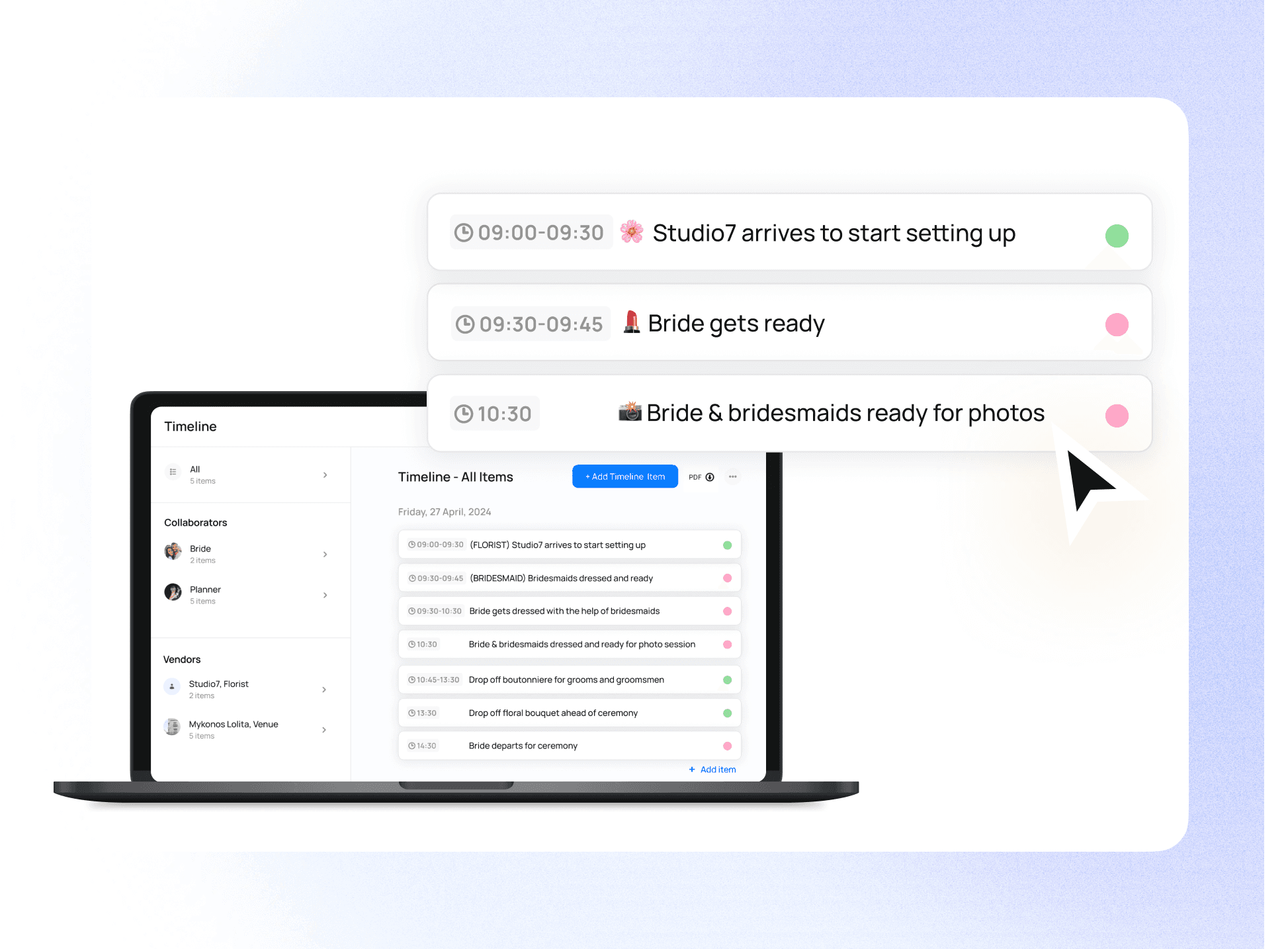
Build the schedule in TTO: bulk-shift the whole schedule or just selected items when timings move, hold unconfirmed slots with TBD placeholders, and use AI-assisted import to turn an existing timeline file into structured, editable items.
Crafting the Perfect Wedding Day Timeline: An Hour-by-Hour Guide
Table of Contents
Introduction: Why Your Timeline Matters More Than You Think
Your wedding day timeline is the invisible architecture of your celebration. Get it right, and the day flows seamlessly. Get it wrong, and you'll feel rushed, stressed, and like you missed moments you'd been dreaming about.
After analyzing the 'Timeline & Programme' category—one of the top 5 task categories with nearly 4,000 tasks—we've identified the patterns that separate smooth weddings from chaotic ones.
The Golden Rules of Wedding Timelines
Before diving into the hour-by-hour breakdown in our wedding day timeline builder, here are the principles that appeared consistently in well-executed wedding timelines:
Build in buffer time: Add 15-30 minutes between major transitions
Work backward from ceremony time: Everything flows from this anchor point
Account for photography: Your photographer needs specific windows of light and time
Communicate early and often: Every vendor should have the timeline at least 2 weeks out
Assign a timeline keeper: Someone (ideally your planner) who watches the clock so you don't have to
Morning: Getting Ready (6-8 Hours Before Ceremony)
The getting-ready period is where hair and makeup happens, detail photos are captured, and the emotional buildup begins. Our data shows this window needs more time than most couples allocate.
8:00 AM | Hair and makeup team arrives; first person starts hair |
8:30 AM | Light breakfast available; relaxed atmosphere |
9:00 AM | Photographer arrives for getting-ready coverage |
9:30 AM | Bride starts hair (usually last in rotation) |
10:30 AM | Detail shots: dress, shoes, jewelry, invitations, rings |
11:00 AM | Bride starts makeup |
12:00 PM | Bridesmaids get dressed |
12:30 PM | Bride gets into dress (allow 30 minutes) |
Critical Timing: Hair and Makeup Math
Our analysis of 4,000+ hair and makeup tasks revealed the timing formula that works:
Hair: 45-60 minutes per person
Makeup: 30-45 minutes per person
Bride typically goes last (freshest look for ceremony)
Start time = Ceremony time minus (total HMUA hours + 2 hours buffer)
Example: 4 PM ceremony with 6 people getting styled = start at 7 AM
Yes, that means early mornings for afternoon ceremonies. The couples who started too late consistently reported feeling rushed and stressed.
First Look vs. Traditional: Timeline Implications
The decision to do a first look dramatically affects your timeline. Here's how the data breaks down:
First Look Timeline
Requires 2-2.5 hours before ceremony for first look + portraits | Traditional Timeline
Requires full cocktail hour (60-90 min) for photos after ceremony |
The Ceremony Window
Most ceremonies run 20-30 minutes, but the full ceremony window needs more planning:
-30 min | Guests begin arriving |
-15 min | Ushers actively seating guests |
-5 min | Mothers and grandmothers seated |
-2 min | Groom and groomsmen take positions |
0 | Processional begins |
+5 min | Bride enters |
+25-30 min | Ceremony concludes, recessional |
+35 min | Receiving line OR guests directed to cocktails |
Cocktail Hour: More Strategic Than You Think
Cocktail hour isn't just social time—it's a critical buffer that serves multiple purposes:
Photo time: If no first look, this is when couple and family portraits happen
Room flip: Allows venue to transition from ceremony to reception setup
Guest mingling: Sets the social tone for the evening
Couple's reset: Brief moment to breathe and be together
Our data shows 60-90 minutes is optimal. Shorter than 60 minutes creates photo stress; longer than 90 minutes and guests get restless.
Reception Flow: The Data-Backed Sequence
Analysis of thousands of reception timelines revealed this optimal flow:
5:30 PM | Guests invited into reception |
5:40 PM | Wedding party introductions |
5:45 PM | Couple's grand entrance |
5:50 PM | First dance |
6:00 PM | Welcome toast (keep to 3-5 minutes) |
6:05 PM | First course served |
6:30 PM | Maid of Honor speech |
6:45 PM | Main course served |
7:15 PM | Best Man speech |
7:30 PM | Parent dances |
7:45 PM | Cake cutting |
8:00 PM | Open dancing begins |
9:00 PM | Late-night snacks (if applicable) |
10:00 PM | Last dance |
10:15 PM | Send-off |
Common Timeline Mistakes to Avoid
The data revealed these recurring issues in problematic timelines:
Underestimating transport time between venues
Not accounting for group photo organization time
Scheduling sunset photos without checking actual sunset time
Back-to-back speeches (space them out through dinner)
Forgetting vendor meal time
No buffer before send-off for couple to change or gather belongings
Running This Timeline in TTO
Once you've mapped the day, build it in TTO so schedule changes don't mean starting over:
Bulk time shifting: when the ceremony moves 30 minutes, shift the whole schedule or just selected items instead of re-entering every timestamp.
TBD placeholders: keep unconfirmed timings on the timeline as TBD until vendors lock them in.
AI-assisted timeline import: upload an existing timeline file and it becomes structured, editable items.
And if you run planning calls over Zoom, TTO's Zoom integration brings meeting recaps into TTO Notes as notes and action items you can move to the right event — it captures decisions and follow-ups, it never builds your timeline automatically.
Conclusion: Your Timeline is Your Day
A well-crafted timeline lets you be present in each moment instead of wondering what comes next. Use these patterns as your starting framework, then customize based on your priorities, your venue's constraints, and your photographer's recommendations.
Remember: the goal isn't to stick rigidly to every timestamp—it's to create a flow that feels natural while ensuring nothing important gets missed.
— END OF ARTICLE —
Further reading:
Try your 30 day free trial here or book a demo.