The Multi-Currency Reality of Destination Weddings

Kat Trefilova — CEO & Founder
Key Takeaways
Payment norms vary sharply by country: India runs 99.7% bank transfer while Poland sees 18.7% cash — research your destination's expectations before assuming.
Treat each currency as its own budget: your EUR and GBP spending are effectively two separate ledgers.
Hold funds in the destination currency via a multi-currency account, and lock in exchange rates on large payments like venue deposits.
Hidden costs add up: wire fees, exchange markups, and card fees can quietly add $3,000-5,000 to a $100,000 destination wedding budget.
Table of Contents
Bank Transfer Dominates Everywhere, But...
India (INR): 99.7% bank transfer—cash and cards virtually unused
South Africa (ZAR): 98.2% bank transfer
Australia (AUD): 89.8% bank transfer
US (USD): 65.2% bank transfer—more card usage (25.6%) and even checks (3.4%)
Cash Is More Common in Some Markets
Poland (PLN): 18.7% cash payments
Decor vendors globally: 16% cash
Hair & Makeup: 16.2% cash (often smaller amounts, day-of payments)
6 Essential Tips for Managing Multi-Currency Payments
Open a multi-currency bank account or use a service like Wise. Holding funds in the destination currency protects you from exchange rate fluctuations.
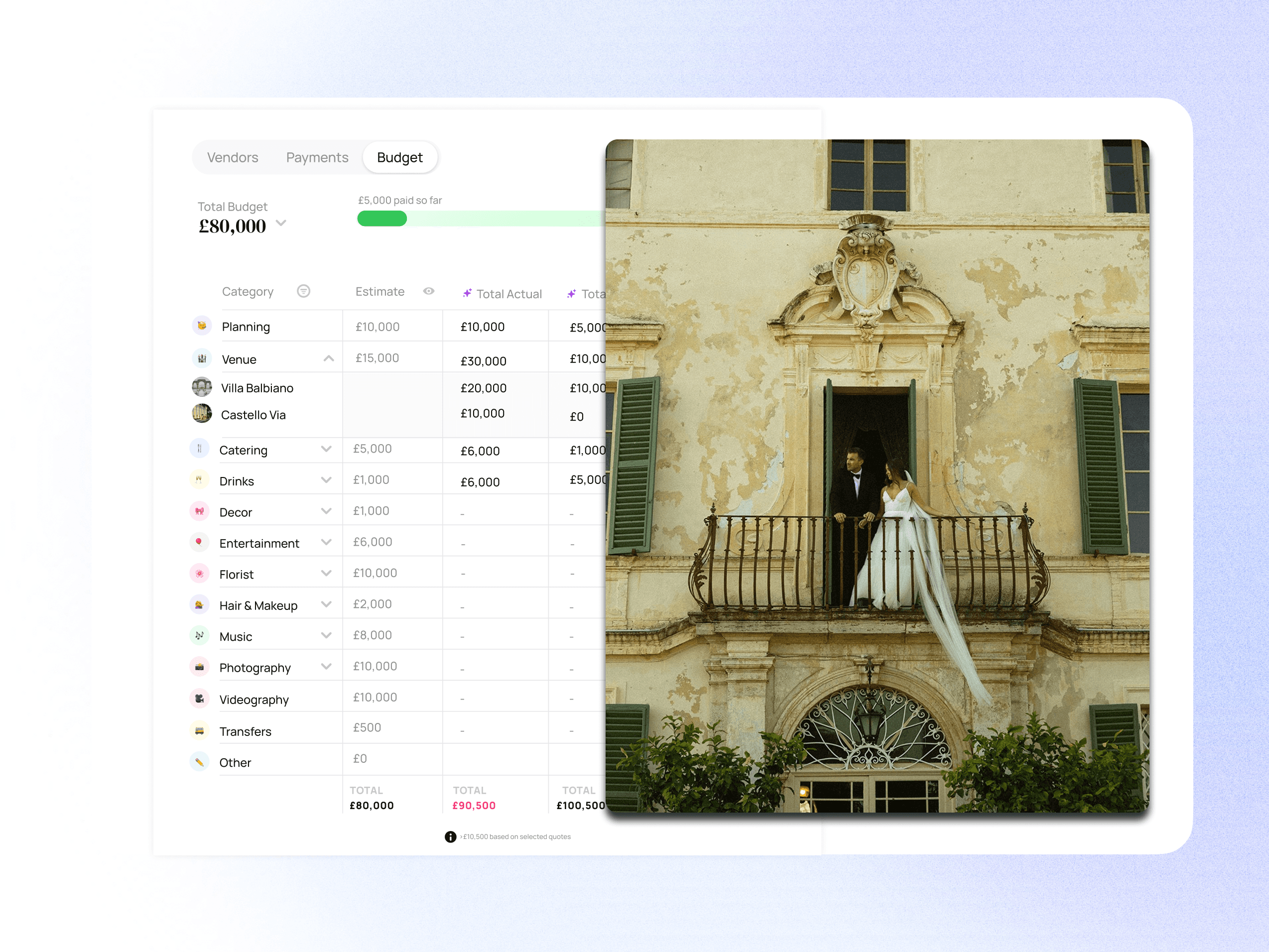
Track each currency's payments separately. Your EUR budget and GBP budget are essentially two different budgets—don't mix them up.
Negotiate the payment currency when possible. Some vendors will accept your home currency—ask before assuming.
Lock in exchange rates for large payments. For venue deposits or caterer fees, consider forward contracts to avoid currency risk.
Research payment norms for your destination. Some countries expect bank transfers only; others are flexible with cards.
Plan for cash needs. Hair, makeup, tips, and last-minute vendor payments often require local cash.
The Hidden Cost: Foreign Transaction Fees
Remember that every international payment can include hidden costs:
Bank wire fees: Often $25-50 per transfer
Exchange rate markup: Banks often add 2-4% to the mid-market rate
Credit card foreign transaction fees: Typically 3% of the transaction
Intermediary bank fees: Sometimes an additional $15-25 is taken along the way
On a $100,000 destination wedding budget, these fees can add up to $3,000-5,000 in unnecessary costs. Shop around for the best international payment solutions.
—
Based on analysis of 21,802 wedding payments across 23 currencies from 1,653 weddings.
Where this data comes from
Every figure above comes from 21,802 vendor payments in 23 currencies, logged across 1,653 weddings planned on That’s The One. We calculated payment-method shares separately for each currency, so a smaller market like Poland is read on its own base instead of being drowned out by EUR and GBP.
What exchange rates do to a wedding budget
In 2023 the Mexican peso gained 8.8% against the dollar, its longest rally in 15 years. Fortune reported that spending by foreign visitors to Mexico fell 7.2% that August, the first drop since 2021, because everything had quietly become more expensive in dollar terms. Mexico is the most popular destination-wedding country for American couples. A couple who signed a peso-denominated venue contract in 2022 and settled the balance in late 2023 paid thousands more than they budgeted, and no vendor raised a single price.
Fees compound the problem. Research commissioned by Wise found Americans lose $16.3 billion a year to fees on money sent and spent abroad, and more than half of that was hidden inside marked-up exchange rates rather than shown as a charge. That same markup sits on every venue balance and photographer deposit a couple wires overseas.
So keep each vendor’s balance in its contract currency. A EUR venue bill and a GBP photographer bill are two different budgets; converting them into one home-currency number hides the drift between contract and final payment. For actually sending the money, a multi-currency account is usually the cheapest route, and on the biggest payments it’s worth locking a rate once dates are fixed.
One more practical note from the data: hair and makeup artists (16.2% cash) and décor teams (16%) are the vendors most likely to want cash on the day. Agree the amount and the currency in advance, or the couple ends up hunting for an ATM in a resort town on the morning of the wedding.
That’s The One tracks vendor payments and due dates in 20+ currencies per event, so each wedding’s budget stays in the money it’s actually paid in.
A small workflow note: dates change at the border too
Currencies are not the only thing that reads differently across markets — date formats do too. 05/07 reads as May 7 to a US guest and 5 July to a UK guest, which matters when vendor due dates and guest-facing deadlines cross borders. That’s The One lets planners configure date formats at the business, event, and guest level, so every audience sees dates the way they expect — and those settings sit alongside budgets that work with multiple currencies in the same event. One workspace, read correctly by everyone in it.
FAQ
What currency should destination wedding vendors be paid in?
The vendor’s local currency, by bank transfer, in nearly every market we analysed. Some vendors will happily invoice in dollars or pounds, but that usually means they’ve built their own exchange-rate buffer into the price. Whatever you agree, write the currency into the contract.
How can couples avoid foreign exchange fees on wedding payments?
Hold and send funds through a multi-currency account rather than a high-street bank, and compare the offered rate against the mid-market rate before every large transfer; the gap between the two is the real fee, per Wise’s research. Settling the largest balances when the rate is favourable beats waiting for the deadline.
Further reading:
Try your 30 day free trial here or book a demo.